

What Jesus teaches about forgiveness after the Lord’s Prayer.
Matthew 6:14–15 is found right after Jesus teaches the Lord’s Prayer in the Sermon on the Mount. The prayer is simple and direct, focussing on God’s name, kingdom, provision, protection, and forgiveness. Then He circles back to one line from the prayer “Forgive us our debts, as we also have forgiven our debtors.”
Jesus understands that forgiveness is a sticking point for many of us so he makes a special point of highlighting it.
In first-century Israel, “debt” wasn’t just about money. It was also a common way to speak about moral and spiritual failures. People understood that sin created a debt before God and also fractured relationships with others.
While many religious leaders of the day focused on scorekeeping and “an eye for an eye”, Jesus taught that receiving God’s forgiveness and offering forgiveness to others are connected. Not because we can earn God’s grade but because, when we refuse to forgive others it blocks the flow of grace in our own lives.
The Verse
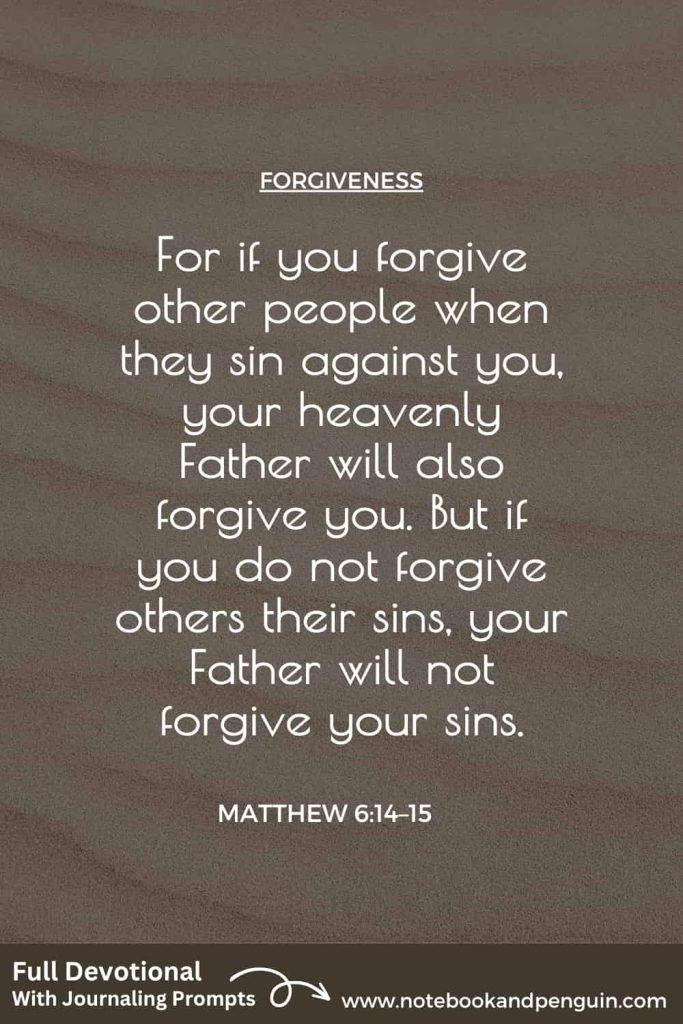
For if you forgive other people when they sin against you, your heavenly Father will also forgive you. But if you do not forgive others their sins, your Father will not forgive your sins.
Matthew 6:14–15 (NIV)
Breaking down Matthew 6:14–15
Let’s take a closer look at what Jesus is saying in this verse.
“For if you forgive other people…”
Jesus starts with “if,” because forgiveness is a choice we all have to make – this means we can choose not to forgive. Forgiveness is not automatic and it’s not easy so we have to make a decision to do it, often repeatedly.
“…when they sin against you…”
Notice that Jesus says, “when they sin against you.” Not “if.” People will hurt you and fail you. They’ll say the wrong thing, forget the important thing, cross a line, break a promise. This is the reality of relationships.
“…your heavenly Father will also forgive you.”
This is God’s promise. God’s heart always leans toward mercy and when we align with Him and release others, we find ourselves living wide open under His forgiving love.
“But if you do not forgive others their sins…”
Jesus then gives a warning that’s not meant to make you paranoid or afraid, but rather a wake-up call. Refusing to forgive isn’t a small personality quirk, it’s a spiritual blockage. It hardens your heart, fuels bitterness, and slowly isolates you from God’s grace. It’s like living with a clenched fist, holding onto negativity rather than letting go and letting God’s grace and love flow through you.
“…your Father will not forgive your sins.”
This is hard to hear and I think Jesus meant it to be that way. It’s imporant to note that he’s not teaching salvation through what we do, but rather that our experience of God’s forgiveness (our ability to receive it, enjoy it, and walk in it) is tied to our willingness to extend it.
Why this Type of Forgiveness matters today
Unfortunately, we live in a time of call-outs, cancellations, and constant outrage. I don’t know about you but it feels like everyone is angry and upset about something, and that anger often comes with a strong sense of entitlement.
But over time unforgiveness becomes a cage you carry everywhere. In the end, it imprisons you and keeps you from the life God wants for you.
Remember that forgiveness doesn’t erase the hurt but rather it releases the hold. It places the debt in God’s hands so you can walk free. Sometimes forgiveness often happens in layers. You forgive today. Next week the memory pops up, and you forgive again. Months later, you feel the sting; you release it once more. Each time, its hold over you weakens and your heart grows softer, stronger, freer.
Reflection Questions About Forgiveness
- When you pray the Lord’s Prayer, do you notice any resistance around the forgiveness line? Why do you think this is? Do you think this feeling is directed towards anything or anyone in particular?
- Whose “debt” are you still holding onto? What do you feel they owe you – an apology, acknowledgment, restitution, time? Name each of these before God.
- In what ways has unforgiveness affected your peace, prayer life, or relationships? How would your inner world change if you released this debt today?
- What boundaries would make forgiveness safer and wiser for you in this situation? Is there someone who can help you establish and maintain them?
- Forgiveness doesn’t mean relationship. How does this line make you feel? Is there anyone in your life that you need to forgive but who you also need to let go of and remove from your life?
- Think about a time God forgave you. How could remembering that moment soften your feelings toward someone else?
- Which step in forgivenenss is God inviting you to right now? Release, rebuild trust, or reconciliation? What is one concrete action you can take this week towards this?
Affirmation
I refuse to be a dead-end for grace. Today I open my hands, release the debts I’ve been carrying, and choose the freedom of forgiveness.
Closing Prayer
Heavenly Father,
Thank You for the cross, where my unpayable debt was canceled. Thak you for Your mercy is my life. I confess the grudges I’ve nursed and the receipts I’ve kept. I lay them down now at Your feet. I choose to forgive those who have sinned against me, and I entrust justice and outcomes to You. Where I need to set boundaries, give me wisdom and courage. Where reconciliation is possible, prepare both hearts and guide my steps. Holy Spirit, soften what has become hard in me, and keep my heart aligned with the heart of Jesus.
In Jesus’ name, amen.