

God’s mercy, freedom from guilt, and living forgiven
Psalm 103 is one of David’s most loved songs. Although we aren’t sure, David likely wrote it later in life, after years of highs and lows, victories and failures, joy and grief, closeness with God and seasons of wandering. By the time you reach verses 10–12, you understand that he isn’t just speculating about God’s mercy; he’s singing from experience.
Psalm 103 is a clear message that God forgives all our sins, heals our diseases, crowns us with love and compassion, satisfies our desires with good, works righteousness and justice for the oppressed, is compassionate and gracious, slow to anger, abounding in love. And, that He removes our sins from us!
This isn’t just theory or religious doctrine. It’s a promise that you can build your life on, especially if you carry guilt, regret, or the nagging fear that God is still holding something against you.
The Scripture
He does not treat us as our sins deserve or repay us according to our iniquities. For as high as the heavens are above the earth, so great is his love for those who fear him; as far as the east is from the west, so far has he removed our transgressions from us.
Psalm 103:10–12 (NIV)
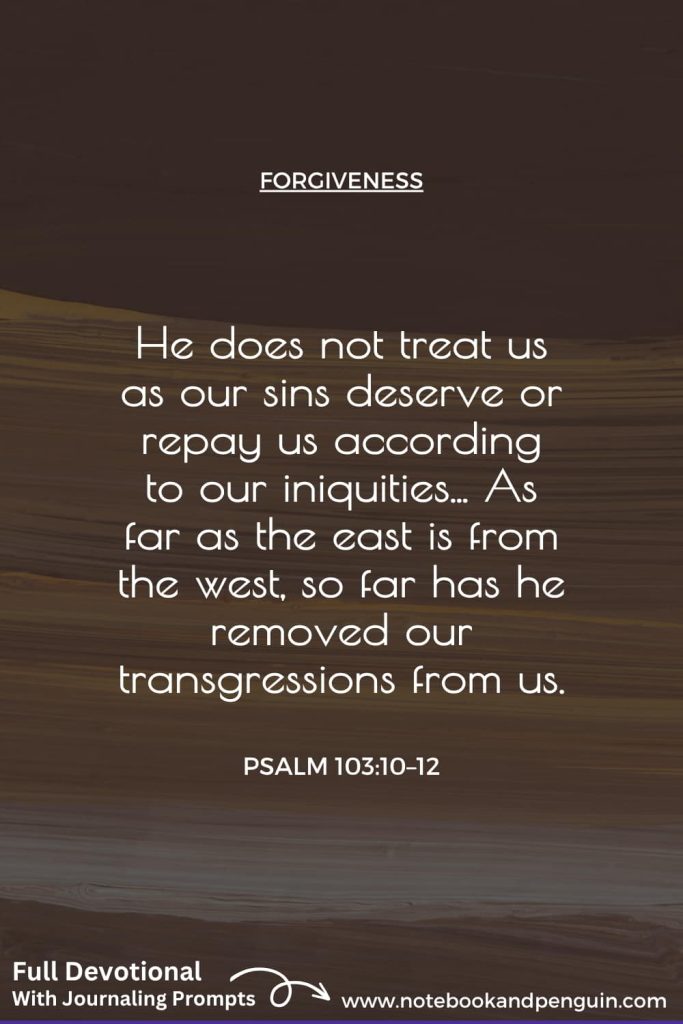
A breakdown of Psalm 103:10-12
“He does not treat us as our sins deserve or repay us according to our iniquities.”
If God gave us exactly what we deserved, none of us would be free of guilt and we would all be condemned. Yet God chooses mercy. This doesn’t mean that He overlooks sin. It means that He chooses a different way to deal with it – through Jesus’ sacrifice on the cross. Instead of giving us what we deserve, God pays for our sin Himself.
“For as high as the heavens are above the earth, so great is his love…”
God’s love for us is immeasurable: “as high as the heavens above the earth“.
“…for those who fear him.”
This doesn’t mean live in fear and terror. It means those who turn toward Him in trust and humble obedience.
“As far as the east is from the west…”
David is painting a picture of absolute separation. God doesn’t just forgive in a technical sense while keeping your sins in the back of His mind. Instead, He utterly and decisively removes them from you.
“…so far has he removed our transgressions from us.”
Transgressions are our willful crossings of God’s boundaries. The stubborn parts, the parts where we do things that we know are wrong, but do them anyway. Even these, God removes from us.
Faith in Action
Here are a few simple and honest steps you can take this week to live Psalm 103:10–12.
- Write down one sin or failure that keeps resurfacing in your mind, even after you’ve confessed it to God. Under it, write Psalm 103:12: “As far as the east is from the west…”. Now pray, “Father, You have removed this from me in Christ. Teach my heart to agree with You.” Destroy the paper as a symbol of release. When the memory returns, answer it with this verse.
- Before your feet hit the floor in the morning, pray Psalm 103 over yourself: “Father, thank You that You do not treat me as my sins deserve. Your love for me reaches higher than the skies. As far as east is from west, You have removed my sins from me.” Start your day in victory instead of shame.
- When your inner critic starts condemning you, respond with God’s Word. Here are a couple of ideas:
- Psalm 103:12: “He has removed my transgressions far from me.”
- Romans 8:1: “There is now no condemnation for those in Christ Jesus.”
- Micah 7:19: “You will cast all our sins into the depths of the sea.”
Say them out loud. Truth breaks the loop.
- Think of someone who has truly apologized and shown change, yet you still bring up their past. Consider how God treats yours. Choose to stop weaponizing old failures. If appropriate, say, “I’ve been holding your past over you. I’m sorry. I would love a fresh start.”
- If your past sin had practical consequences, forgiveness doesn’t erase responsibility. Make amends where needed. Set boundaries. Ask for accountability. Mercy fuels maturity.
Reflection Questions
- Which phrase from Psalm 103:10–12 do you most need today: “He does not treat us as our sins deserve,” “as high as the heavens,” or “as far as the east is from the west”? Why?
- Do you have any old regrets or confessed sins that still cling to you? What would it look like if you believed God’s promise that He has removed them from you?
- When you come to God in prayer, do you come like a beloved child or like a guilty convict? How could Psalm 103 reshape your thinking?
- Is there someone whose past you keep coming back to in conflict or in your mind? What step could you take to treat them with the mercy God has shown you?
- Is there anywhere in your life where you might need to pair “I am forgiven” with “I will make it right” (amends, restitution, boundaries)?
Affirmation
In Christ, I am forgiven and free. I will live as a beloved child and extend mercy to others.
Closing Prayer
Heavenly Father,
Thank you that You do not treat me as my sins deserve. Your steadfast love over me is higher than the heavens, and in Christ, You have removed my sins as far as the east is from the west. Where shame still whispers, silence it with Your truth. Teach me to live like a forgiven person – humble, joyful, and merciful. Help me stop rehearsing what You have removed and to extend the same mercy to others that You extend to me. Guide me in any steps of amends or boundaries that honor You. I rest under Your love today.
In Jesus’ name, amen.


